Ice Bucket Challenges Around the World

In the streets of Hyderabad, a city in south India home to some six million people, journalist Manju Latha Kalanidhi pulled out his bucket.

Unlike hordes of Canadians, Americans, Brits, and others who have been filling their buckets with ice and water, Kalanidhi filled his with rice. After loading it up, he didn’t dump it over his head – instead, he donated it to the country’s poor and hungry population.

Dubbed the #RiceBucketChallenge, the spirit of giving is in the early stages of sweeping the nation. So far, the campaign’s Facebook page has received over 54,000 Likes.

India charity ALS

These four steps make up the #RiceBucketChallenge. a campaign starting up in India.

The team behind Thrill, a start-up dating app, took to the streets to participate, and their video gives a good example of what this new campaign is all about:

http://www.youtube.com/watch?v=EbLROtlZXVg

As reported by Reuters, other companies institutions are also trying to get more people involved. The Indian Institute of Management has already participated, while AirAsia India said that its senior management will complete the challenge next week. As more companies join on board and send out nominations for others to join, the hope is the campaign will continue to snowball.

Continue reading

UVic’s Brilliant Use of BuzzFeed

If you’ve ever attended, applied to, or even just stepped foot close to a university campus, you’ve probably seen them. Bright, colourful photographs of students showing off their school colours in all sorts of safe locales. Maybe they’re sitting in a campus café, or lounging under a giant maple tree, or chatting at a study table in the library, or just philosophizing on the meaning of life and their place in the world on the steps of the campus’ most iconic building.

These pictures are everywhere. And they’re unrealistic. The photos often feature those representing the student union, showcase clothing that would decimate a student’s budget faster than happy hour, and represent a homogenous school culture that appears to be the exact same no matter what campus you step foot on. Despite these shortcomings, this approach perseveres as the norm.

But could that be changing?

@cspeti4 Instagram photo samples

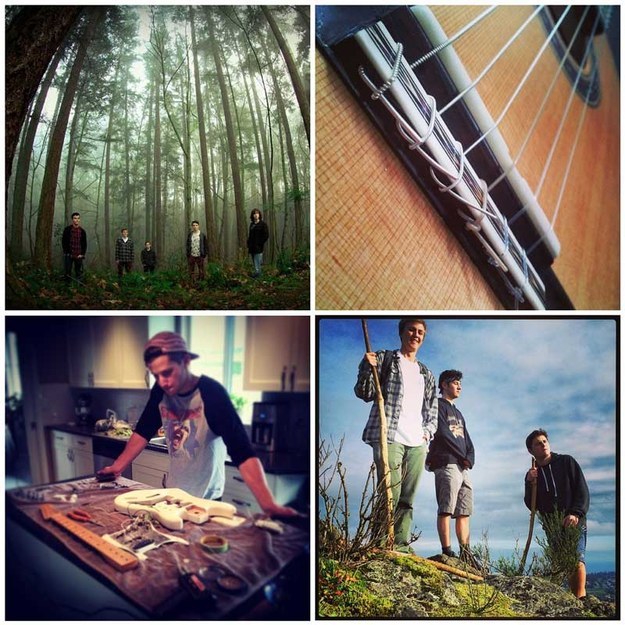
One of the students the University of Victoria featured in their BuzzFeed article, Corey. All photos from @cspeti4 on Instagram.

Enter: the University of Victoria.

While they’re still very much in the experimental phase, UVic has signed up as a “Brand Publisher” on the internet giant BuzzFeed. As one of the web’s most visited sites, which pumps out shareable stories by (what feels like) the minute, the fit might seem odd for a stuffy-old institution like a university to host its stories.

In reality,  it’s a perfect opportunity. They’re putting content out on the places that their students (both current and prospective) spend their time, as evidenced by Alexa’s response that people browsing from school are greatly over-represented on BuzzFeed. Rather than trying to drive traffic to their site, they’re being active in pushing out stories through a medium that students actually want to spend time on.

Continue reading

Google Glass, Meet Citizen Journalism

Citizen journalism just got a whole lot more high-tech.

CNN is bringing iReport, their citizen journalism site that allows anyone to post content free of editing, fact-checking, and screening, to Google Glass. This will expand the opportunity for iReporters to submit video and photo coverage of breaking news as it happens.

As with all other content on iReport, CNN can choose to edit and ensure the validity and credibility of photos or videos taken with Google Glass, and broadcast them on their platforms during live, or recorded, news coverage.

Using user-generated content in order to stay on top of spot news is nothing exclusive to CNN, of course. In times of immediate breaking news, especially during times of emergency (natural disaster, security concerns, etc.) TV news outlets scramble to ask permission to use tweeted photos or call for their viewers to submit content to them.

The tragic events and subsequent investigation of last year’s Boston Marathon bombings became one of the first real explorations of the power of crowdsourced news during crises in the U.S. In Canada, a shooting in the food court at Toronto’s Eaton Centre demonstrated the same shift north of the border.

While news teams rush to gather their equipment or redirect their van to the scene of events, smartphones and tablets of those on scene were already capturing the action. The major broadcasters repurposed tweets, Instagram photos, and YouTube videos of the scene at the Marathon’s finish line. During the pursuit of the perpetrators in the following days, the news media relied on social media to get images of the police sweep. Andrew Kitzenberg had his photos of the manhunt shared across not only social media, but the television screens of major broadcasters. CNN even profiled Kitzenberg in the video below.

Continue reading

Twitter Activism on a Local Level: The Day a Bridge Tweeted

“I am frustrated….I am alone and cold and I have been left all alone here for a long time!”

These words make up the biography for the “Airport bridge” Twitter account. That’s right, the airport bridge.

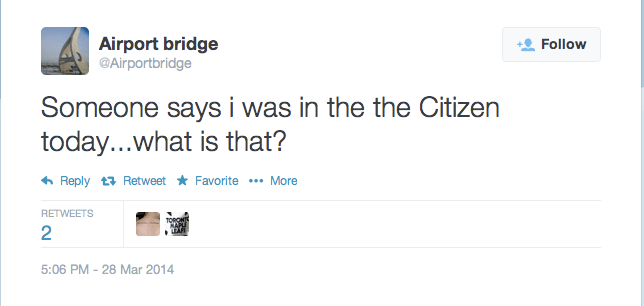
Snapshot of Airport Bridge Twitter account

The Twitter account continuing to play up the non-human character.

Launched Monday of this week, the account personifies one of Ottawa’s longest-running municipal disasters, a proposed pedestrian bridge originally scheduled to be completed in October 2011. Nearly three years later and $4.5 million over budget, the bridge remains incomplete.

The bridge has faced a number of problems, from faulty concrete that needed to be torn down and re-poured to rethinking its entire design. While the city expects the bridge to be complete by this year, no construction is currently underway.

As a result, one fed-up citizen decided to take the matter into her/his own hands, and where better to turn than social media?

After a relatively quiet first two days, the Huffington Post published a story about the Twitter account on Wednesday night, when it had 35 followers. By Thursday, the account had taken off. At the time of writing, the bridge’s account was up to over 620 followers.

While the creator of the account has been extremely loyal to the idea of being a personified version of the bridge as opposed to revealing his/her identity, s/he has remained active in pursuing media attention.

Continue reading

State of the Journalism Industry – Highlights from the AEJMC

I have the fortunate opportunity to be spending this weekend in Washington, D.C., as I have been invited to the annual conference put on by the Association of Educators in Journalism and Mass Communication to present one of my papers.

This afternoon I was able to attend the conference highlight I was most looking forward to, a panel discussion on the state of the industry featuring Tom Rosenstiel of the American Press Institute; Jim Brady, who is editor-in-chief of Digital First Media and president of the Online News Association; Rob Mennie of Gannett Broadcasting; Karen Dunlap, president of the Poynster Institute; and the host of the panel session, Bob Papper of Hofstra University.

I cannot begin to describe how insightful, interesting and exciting this discussion was. Not surprisingly, engagement was a theme that resonated throughout the session. What was interesting, however, was the idea of a return civic journalism and commitment to communities being regarded in very high standards by news outlets.

Without further ado, I present some highlights from these powerful speakers.

Tom Rosenstiel

  • Previously, consumers had to adapt their behaviours to accommodate the media (in terms of news at specific times, for example). Today, the news media need to adapt their cycle and behaviours to suit the audience.
  • We are in a period of democratization and a type of enlightenment, in this sense.
  • Audiences are consuming more news today, not less. 25% of people state they are consuming more news, while only 10% say they are consuming less. Among those who consume through mobile technologies, 32% say they are consuming more and only 8% consuming less.

Continue reading

Obama Opens Up Online

From The Millstone – August 30, 2012

—–

In the early evening of Wednesday, the United States President Barack Obama got a chance to answer questions directly from voters (Democrats, Republicans, and undecideds alike). However, this wasn’t your basic open forum at a debate, town hall, or rally. No, President Obama sat down at a laptop in a room in Charlottesville, Virginia, and answered questions from anonymous askers on the online social news site, reddit.

Shitty_Watercolour, a popular reddit user, welcomes President Obama with one of his works.

Fresh off the heels of a rally at the host city of the University of Virginia where Obama appealed to the youth vote, he further showed his dedication to the youth vote with his reddit Q&A, colloquially known as an AMA (Ask Me Anything) on the site.

For those unfamiliar with the site reddit.com, it’s difficult to explain. The site is an open-source social news site, where users have the ability to post photos, links (to newspaper articles, websites, etc.), or start discussions in one of thousands of “sub-reddits”. Other users then have the opportunity to comment on the original post. The sub-reddits each have a different focus (the list is endless, ranging in everything from US politics, to funny images, to city-specific reddits like Ottawa, to hobbies and jobs), with one dedicated specifically to these AMA’s.

The AMA’s have quickly become a kind-of hidden secret for politicians, as Obama is not the first to face the reddit hive. Previously, the likes of Republican presidential candidate Ron Paul, Colorado representative Jared Polis, and others have taken to the web to answer questions.

When Obama went up, the site went crazy with excitement (even leading to the site occasionally crashing.) The AMA has received over 19,000 comments at the time of writing, and that number will likely only grow as those from other parts of the world continue to log on and see.And while Obama dedicated 30 minutes out of his busy campaign trail to “be real” with the reddit community, the question of its success is hard to determine.

Continue reading

Clicking the Way to Social Change

A young Ugandan boy sits in the dark, describing the death of his brother, who tried to escape from a rebel group operating in that nation. The boy fears for his life, after watching his brother’s throat slit, and says he would prefer to be killed than be abducted by the rebel regime.

This was social media’s version of the “shot heard ‘round the world.” Invisible Children, a U.S.-based not-for-profit organization, spread their Kony 2012 project and video across Facebook.

It outraged, upset, and shocked viewers, who “Liked” and shared the video at a rate never before seen. Within less than a week, the video had received over 80 million views.

The focus was Joseph Kony, leader of the Lord’s Resistance Army, a militant group based in Uganda. It discussed Kony’s numerous human rights violations, especially focusing in on the LRA’s use of child soldiers. It ran with the tagline, “Make Kony famous,” a call to make the arrest and capture of Kony a priority of Western governments.

It showed images of the director’s son learning about Kony, and shows them in comparison with Jacob, the Ugandan boy who was terrorized by the leader. It sparked outrage in the hearts of those who watched it.

The video went viral. But, the reality is the movement ran much deeper than that.

As some users across the globe simply watched and spread the video, millions joined in on the sentiment of making Kony famous. University campuses across Canada and the United States set dates for public screenings of the film, while April 20 was declared a day of action for supporters promote the cause publicly in cities across North America.

It seemed a textbook example of clicktivism: the idea of taking social activism online. Kony revealed the ways individuals and organizations harness the power of social media to get increasingly apathetic young people involved in a social movement.

But, in the days and weeks that followed, criticisms of Kony 2012 became the real story. Suspicions of Invisible Children, the facts presented in the video, and co-founder and director Jason Russell quickly overshadowed the original message of the film.

At the forefront, along with the criticisms, was the debate around the actual, practical advantage in using Facebook and other social media platforms. Many media critics questioned how involved and engaged Facebook users who shared the video were. To some degree, the video became a farce.

For example, the Peak newspaper at Simon Fraser University ran a satirical piece that claimed anyone who shared the video on Facebook would receive an honorary degree from the school’s International Studies faculty.

Meanwhile, users of the popular social news site reddit posted maps of Africa, and asked Kony supporters to point out the location of Uganda.

The anti-Kony campaign ignited a debate about the role clicktivism plays in engaging young people in social change: is it activism, or simply slacktivism?

Continue reading