True Detective: Giving Life To Our Favourite Characters Online

Imagine if you could bring your favourite fictional characters to life. To get a peek into how they live outside of the pages of their novel or behind the scenes of their TV show.

Well, with Nic Pizzolato’s philosophical and metaphorical Rustin Cohle, people have decided to do just that. “Rust,” as his few friends in HBO’s smashing new hit True Detective call him, has captured the minds of the more than 12 million viewers who have tuned in weekly for the past two months. On Sunday, the first season wraps up and Rust will make his last appearance on the silver screen.
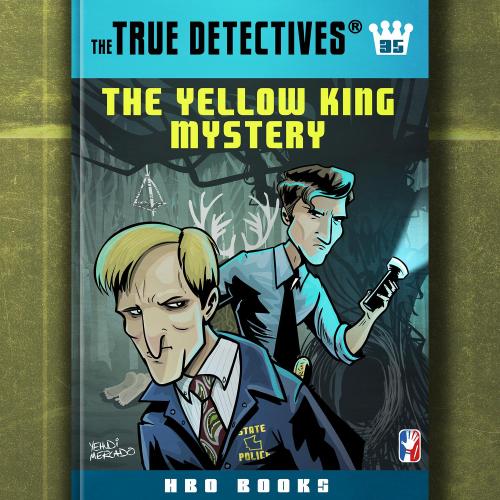
Mystery of the Yellow King fake Hardy Boys book based on True Detective

Copyright © 2014 supermercado
This mockup reimagining True Detective as a Hardy Boys book demonstrates how fans are making the show their own. Click the photo for more details on this piece, and on how to purchase your own.

To put it in the most simplistic way possible, the character of Cohle is deep, dark, and complex. Matthew McConaughey, the actor who took on the challenge of capturing Cohle – and has done an incredible job, according to just about everyone – went so far as to create a 450-page graph to trace Cohle’s life, and many personalities, over the 17 years spanned on the show. These multiple distinct personalities, and a knack for questioning the meaning of life and the universe in utter poetic language, have set Cohle apart as one of the most memorable television characters we’ve seen in this millennium.

People have eaten it up. If “true” television success is to be measured by engagement rather than pure ratings in today’s media environment, True Detective is successful in every way.

Continue reading

Clicking the Way to Social Change

A young Ugandan boy sits in the dark, describing the death of his brother, who tried to escape from a rebel group operating in that nation. The boy fears for his life, after watching his brother’s throat slit, and says he would prefer to be killed than be abducted by the rebel regime.

This was social media’s version of the “shot heard ‘round the world.” Invisible Children, a U.S.-based not-for-profit organization, spread their Kony 2012 project and video across Facebook.

It outraged, upset, and shocked viewers, who “Liked” and shared the video at a rate never before seen. Within less than a week, the video had received over 80 million views.

The focus was Joseph Kony, leader of the Lord’s Resistance Army, a militant group based in Uganda. It discussed Kony’s numerous human rights violations, especially focusing in on the LRA’s use of child soldiers. It ran with the tagline, “Make Kony famous,” a call to make the arrest and capture of Kony a priority of Western governments.

It showed images of the director’s son learning about Kony, and shows them in comparison with Jacob, the Ugandan boy who was terrorized by the leader. It sparked outrage in the hearts of those who watched it.

The video went viral. But, the reality is the movement ran much deeper than that.

As some users across the globe simply watched and spread the video, millions joined in on the sentiment of making Kony famous. University campuses across Canada and the United States set dates for public screenings of the film, while April 20 was declared a day of action for supporters promote the cause publicly in cities across North America.

It seemed a textbook example of clicktivism: the idea of taking social activism online. Kony revealed the ways individuals and organizations harness the power of social media to get increasingly apathetic young people involved in a social movement.

But, in the days and weeks that followed, criticisms of Kony 2012 became the real story. Suspicions of Invisible Children, the facts presented in the video, and co-founder and director Jason Russell quickly overshadowed the original message of the film.

At the forefront, along with the criticisms, was the debate around the actual, practical advantage in using Facebook and other social media platforms. Many media critics questioned how involved and engaged Facebook users who shared the video were. To some degree, the video became a farce.

For example, the Peak newspaper at Simon Fraser University ran a satirical piece that claimed anyone who shared the video on Facebook would receive an honorary degree from the school’s International Studies faculty.

Meanwhile, users of the popular social news site reddit posted maps of Africa, and asked Kony supporters to point out the location of Uganda.

The anti-Kony campaign ignited a debate about the role clicktivism plays in engaging young people in social change: is it activism, or simply slacktivism?

Continue reading